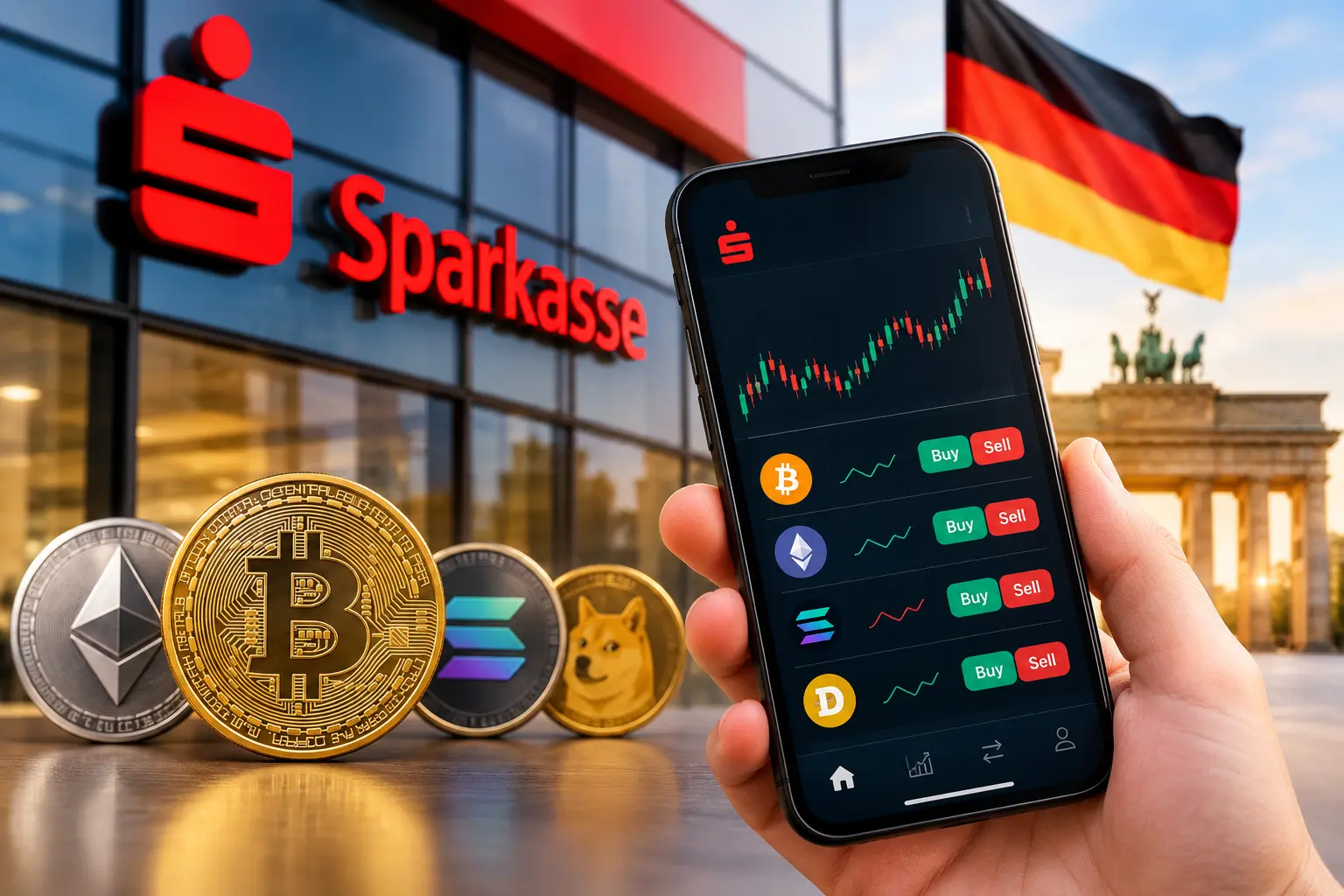
Germany’s savings bank network has opened cryptocurrency trading through its mobile banking app, offering Bitcoin, Ethereum, XRP, Solana and Polygon as it gradually expands access to digital assets.
Germany’s Sparkassen banking network has officially entered the retail cryptocurrency trading market, allowing customers of participating savings banks to buy and sell digital assets directly through the Sparkasse mobile banking app. The service launched on October 19, 2026, with a fixed transaction fee of €0.99 per order.
The new offering, called “Krypto – powered by Deka”, is operated by DekaBank, the securities and investment services provider of the Sparkassen financial group. It initially supports five cryptocurrencies: Bitcoin (BTC), Ethereum (ETH), XRP, Solana (SOL) and Polygon (POL).
The launch marks a significant shift for Germany’s savings banks, which had previously been reluctant to offer cryptocurrency trading because of concerns about market volatility and investor risks. The decision reflects growing customer demand and the development of a European regulatory framework for digital assets.
According to CryptoPotato, the service initially became available through five savings banks: Frankfurter Sparkasse, Taunus Sparkasse, Sparkasse Karlsruhe, Sparkasse Rottal-Inn and Niederrheinische Sparkasse RheinLippe. The rollout will continue gradually, with individual banks deciding when to activate the service.
Sparkassen Plans a Gradual Nationwide Expansion
The German Savings Banks Association (DSGV) expects another 30 to 40 savings banks to join the cryptocurrency trading initiative each month. The association aims to connect a substantial share of interested institutions during the first half of 2027.
However, the service does not have a single nationwide launch date. Availability depends on whether an individual Sparkasse chooses to introduce cryptocurrency trading for its customers.
The integration into the existing banking app could make crypto investing more accessible to customers who prefer managing their finances through a familiar banking platform rather than opening a separate account with a cryptocurrency exchange.
Customers can access the service without opening a traditional securities account. However, the offering is designed for individuals who make their own investment decisions, rather than customers seeking personalised investment advice.
€0.99 Trading Fee: What Investors Need to Know
DekaBank has set a flat fee of €0.99 for every cryptocurrency buy or sell order. According to its September 2026 price information, there is no minimum order size, while the maximum transaction amount is €250,000.
The flat fee makes the service relatively straightforward to understand, but its impact depends on the size of each trade.
For example, a €100 purchase attracts a €0.99 transaction fee, equivalent to 0.99% of the order value. On a €1,000 purchase, the same fee represents approximately 0.10%.
Investors should also account for the additional trading spread. DekaBank calculates its quoted prices using a market reference price plus its own spread, but the published price information does not specify the spread’s exact size.
Consequently, the €0.99 order fee does not represent the complete cost of trading. The spread can affect the effective buying and selling prices, making it important for customers to examine the final quote before confirming a transaction.
DekaBank may also adjust its pricing in certain circumstances, including periods of high market volatility or larger trading volumes.
Crypto Custody Comes With Restrictions
The new service offers cryptocurrency custody through DekaBank, with support from Börse Stuttgart’s digital asset infrastructure. Customers do not have to manage private keys themselves, which may appeal to beginners who prefer a bank-managed arrangement.
However, this convenience comes with an important limitation: customers cannot freely transfer their cryptocurrency to any external wallet address.
Under the published conditions, withdrawals are restricted to approved cryptocurrency service providers, including Crypto Finance, Tangany, Bullish Europe and Börse Stuttgart Digital Custody. Direct transfers to personal hardware wallets are not permitted under the stated arrangements.
This distinction matters to investors who want complete control over their digital assets. Unlike self-custody wallets, where users manage their own private keys, the Sparkassen service relies on a custodial model in which the provider holds the assets on customers’ behalf.
Cryptocurrency holdings are also not protected by Germany’s statutory deposit guarantee scheme. Customers should therefore distinguish between the protections applicable to ordinary bank deposits and the risks associated with crypto investments.
From Crypto Resistance to Market Entry
Sparkassen’s entry into cryptocurrency trading represents a notable change in strategy. The German savings bank group had previously opposed introducing a retail crypto trading service, citing concerns about the risks associated with digital assets.
In 2022, the group’s leadership decided against offering cryptocurrency trading. Its position subsequently evolved as interest in digital assets increased and European regulation developed.
In 2025, the DSGV reversed its earlier stance and tasked DekaBank with developing a crypto trading service. The group cited customer demand and the evolving regulatory environment, including the European Union’s Markets in Crypto-Assets Regulation (MiCA), as factors behind the decision.
The launch places Sparkassen among the established financial institutions responding to growing interest in cryptocurrency investments. It also brings digital asset access closer to customers who may be more comfortable using traditional banking services than dedicated crypto platforms.
Sparkassen Warns Investors About Crypto Risks
Despite launching the service, the Sparkassen group continues to treat cryptocurrencies as high-risk investments. The offering is intended for adult customers who understand the risks and can make independent investment decisions.
The banks are not expected to provide personalised investment advice or promote cryptocurrency trading broadly through their traditional advisory services. Customers are warned about sharp price fluctuations and the possibility of losing their entire investment.
The risks remain significant because cryptocurrency prices can change rapidly in response to market sentiment, regulatory developments, liquidity conditions and broader financial trends.
For investors, the new service offers a more convenient way to access selected cryptocurrencies through an established banking relationship. Nevertheless, convenience should not be confused with capital protection, and the undisclosed spread and restrictions on wallet transfers are important considerations.
What the Launch Means for Europe’s Crypto Market
Sparkassen’s move highlights the gradual integration of digital assets into traditional financial services. By bringing cryptocurrency trading into an existing banking app, the group is seeking to meet customer demand while maintaining a bank-managed trading and custody structure.
The phased rollout will determine how widely the service becomes available across Germany. Its longer-term appeal will likely depend on the overall cost of transactions, the range of supported assets, the ease of use and whether customers consider custodial access sufficient for their investment needs.
For now, the launch offers eligible Sparkassen customers a new route to Bitcoin, Ethereum, XRP, Solana and Polygon. However, investors should compare the total trading cost, understand the custody restrictions and carefully assess the possibility of substantial losses before entering the cryptocurrency market.
Disclaimer: This article is for informational purposes only and does not constitute financial or investment advice. Cryptocurrency investments involve significant risks, including the potential loss of the entire amount invested.
Also read: Cobo Wallet to Shut Down on December 1, 2026; Users Face $100 Minimum Monthly Fee