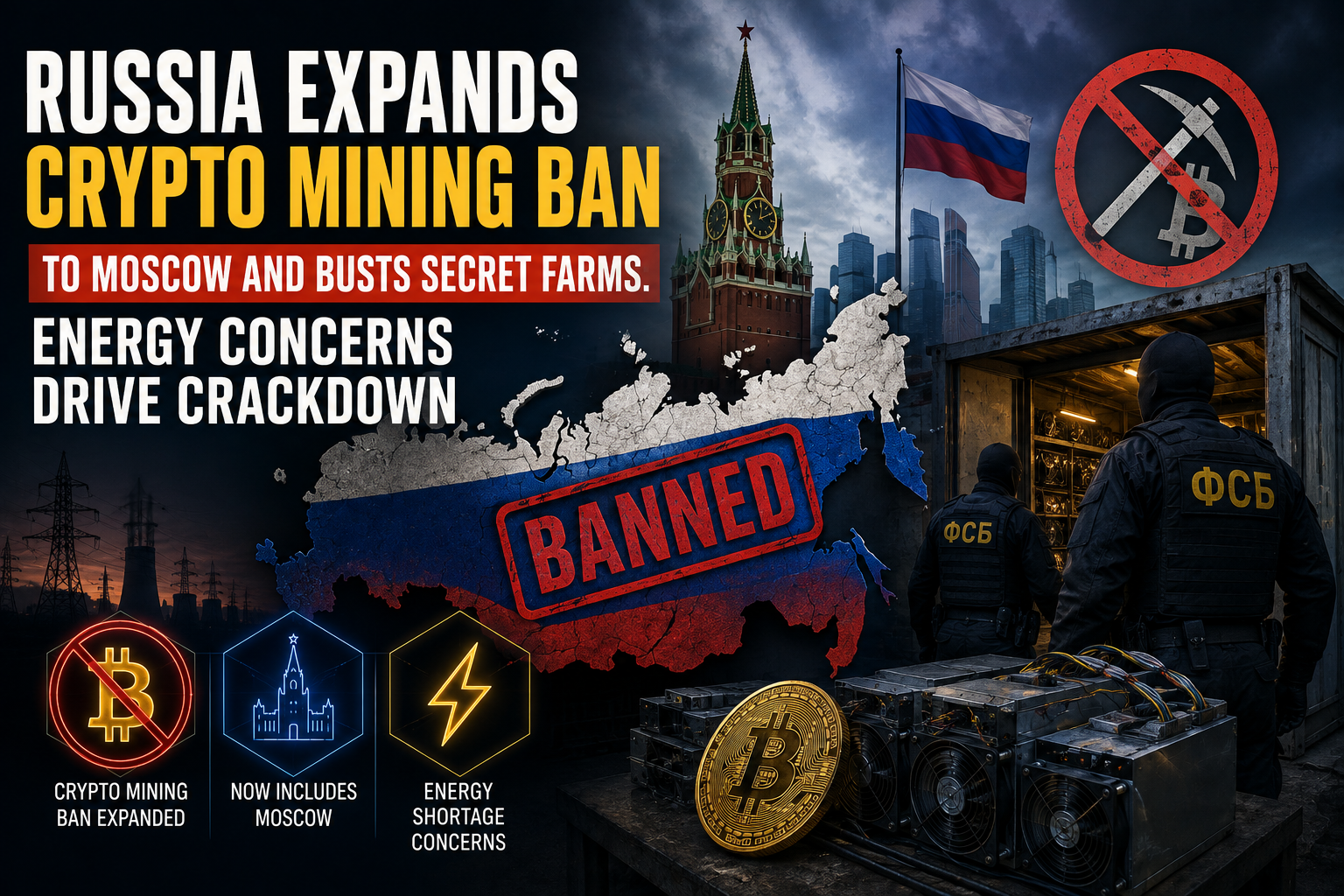
Russia has intensified its regional restrictions on cryptocurrency mining, formally banning the activity in Moscow, the Moscow Region, and selected areas of the Kursk Region starting August 15, 2026. The measure will remain in force until December 31, 2032. At the same time, authorities have dismantled a network of clandestine mining operations in Nizhny Novgorod, highlighting ongoing enforcement against illegal power use.
The Official Mining Ban
According to Government Decree No. 936, signed by Prime Minister Mikhail Mishustin on July 25, 2026, and published on July 31, cryptocurrency mining — including participation in mining pools — is prohibited in Moscow, Moscow Oblast, and eight municipal districts of Kursk Oblast (Belovsky, Bolshesoldatsky, Glushkovsky, Korenevsky, Lgovsky, Rylsky, Sudzhansky, and Khomutovsky), as well as the town of Lgov.
The ban expands existing restrictions already applied in 13 other energy-deficit regions, including parts of Irkutsk Oblast, Buryatia, and Zabaykalsky Krai. Officials cite strained power capacity as the primary driver. The Moscow Region’s energy authorities have estimated that mining and related data-center activity consume around 1 GW of electricity in the capital region, placing significant pressure on the grid without delivering commensurate economic benefits.
Moscow Mayor Sergey Sobyanin and Moscow Region Governor Andrey Vorobyov had previously supported such limits, arguing that high energy demand from mining contributes little to the local economy.
Secret Farms Uncovered in Nizhny Novgorod
In a separate development, police in Nizhny Novgorod discovered a network of nine hidden mining farms while investigating a 37-year-old entrepreneur. The operation involved approximately 120 mining devices concealed in locations including a garage near a railway station, a car wash, residential basements, and containers buried under private land.
Investigators found that electricity meters had been tampered with to underreport consumption, resulting in estimated losses of about 20 million rubles (roughly $252,000). The suspect faces criminal investigation for illegal access to the power grid. This case underscores a recurring issue: even in regions where mining remains legal, some operators attempt to avoid registration and electricity costs by operating underground.
Why Russia Is Tightening Controls
Russia legalized industrial cryptocurrency mining in late 2024 and introduced registration requirements with the tax authorities. However, authorities have consistently used regional bans as a tool to manage electricity shortages rather than as a blanket prohibition on the industry. Energy officials argue that mining’s heavy power draw competes with residential and industrial demand in constrained areas, particularly near conflict zones such as Kursk.
Large-scale miners have historically relocated to surplus-power regions when faced with such restrictions. As a result, these regional bans have not typically produced major shifts in global Bitcoin hash rate or broader cryptocurrency prices. The more immediate impact is local: reduced illegal consumption and stronger pressure on unregistered operators.
Market and Industry Context
The dual actions — expanding formal bans while cracking down on clandestine farms — reflect Russia’s dual-track approach to crypto. While authorities continue to develop regulated frameworks for retail access and cross-border settlements, energy security remains a hard limit on mining activity in stressed regions.
Analysts note that similar restrictions elsewhere have encouraged miners to migrate rather than exit the sector entirely. For global markets, the developments are viewed as largely localized and unlikely to trigger significant price movements in major cryptocurrencies.
Looking Ahead
With the Moscow-region ban taking effect on August 15, 2026, further enforcement actions against unregistered or power-theft operations are expected. Russia’s strategy continues to balance limited crypto integration with strict management of energy resources. How effectively miners adapt by relocating to permitted regions will determine the longer-term shape of the country’s mining industry.
Also read: Unlimit Gains MiCA Licence from CySEC: Crypto-Asset Services Across the EU