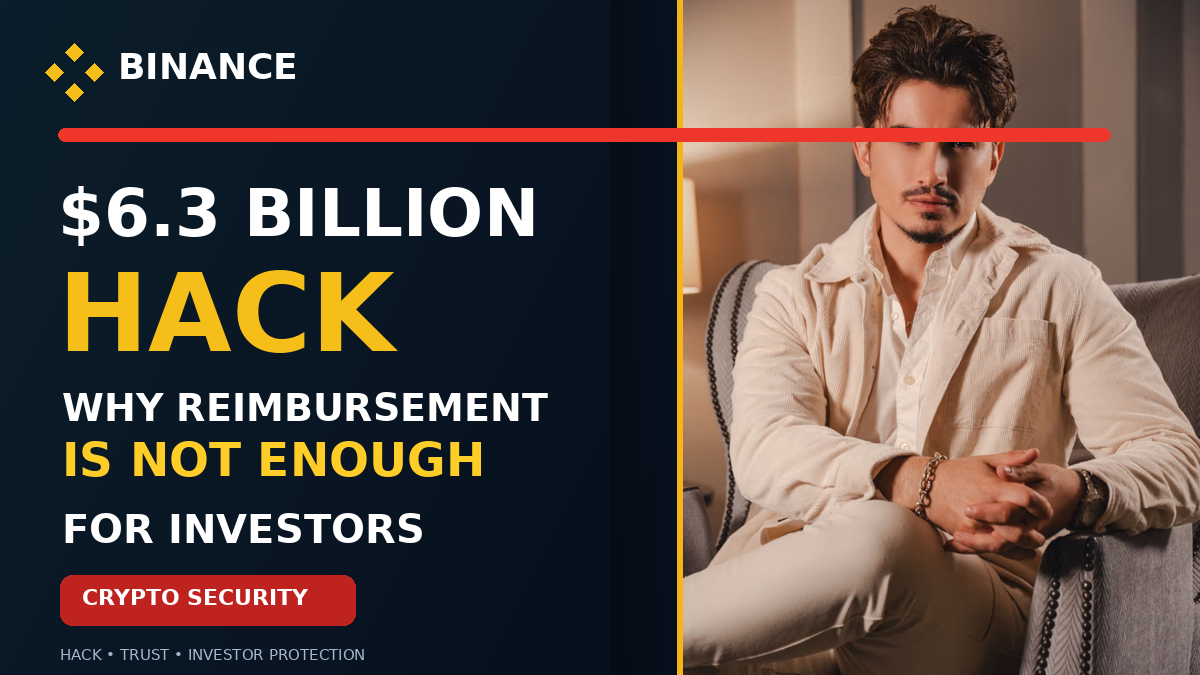
Altcoin Pro co-founder Joni Zhuleku says Binance must provide a transparent explanation, strengthen its security infrastructure and rebuild investor confidence after the massive hack. The incident also raises important concerns for Indian crypto investors about exchange accountability and asset protection.
The massive security breach at Binance has renewed concerns about the safety of digital assets held on centralised cryptocurrency exchanges. Although Binance has promised to compensate affected users, crypto industry experts believe that financial reimbursement alone will not be enough to restore investor confidence.
Joni Zhuleku, co-founder and chief research officer of Altcoin Pro, has warned that the incident highlights deeper weaknesses in cryptocurrency exchange security. According to him, Binance must explain how the attack happened, identify the vulnerabilities that allowed unauthorised transactions and demonstrate that stronger security measures are now in place.
The breach, reported on October 29, 2026, involved approximately $6.3 billion worth of cryptocurrency and has been described as one of the largest digital asset thefts in history. Blockchain analytics firms have linked the attack with TraderTraitor, a hacking group associated with North Korea’s Lazarus Group. crypto.news+1
How Did the $6.3 Billion Binance Hack Happen?
The attack reportedly targeted Binance’s hot wallet infrastructure, which handles cryptocurrency deposits and withdrawals. According to the exchange’s initial investigation, a compromised employee device may have provided attackers with access to internal systems.
However, subsequent information pointed towards a more complex incident involving multiple breach points and the misuse of an Ethereum account delegation feature to bypass normal transaction approval controls.
This is particularly concerning because hot wallets are essential to the daily operations of cryptocurrency exchanges. They allow platforms to process withdrawals quickly, but their internet connectivity also makes them an important target for cybercriminals.
The incident reportedly involved multiple blockchain networks, making it a significant test of exchange-level security and transaction monitoring systems. crypto.news+1
Binance Promises to Cover Customer Losses
Following the incident, Binance announced that it would cover all affected customer losses using its Secure Asset Fund for Users (SAFU) and corporate funds.
The exchange also said that approximately $3 billion in assets connected to the attack had been frozen with the assistance of blockchain partners and other industry participants.
However, there is an important distinction between freezing stolen cryptocurrency and recovering it. Freezing prevents certain assets from being transferred or used, but the process of establishing ownership and returning those assets can involve additional technical and legal procedures.
The response from major industry participants, including stablecoin issuers, has also highlighted the role that centralised entities can play in limiting the movement of stolen digital assets. Binance Announcements, Binance News+1
Joni Zhuleku: Why Reimbursement Alone Cannot Restore Investor Confidence
In his interview with Crypto.News, Zhuleku explained that the biggest concern is not simply the amount of cryptocurrency stolen but the security failures that allowed the incident to reach such a scale.
He pointed out that Binance’s investigation had not established the complete sequence of events. The initial reference to a compromised employee device should not be treated as proof that a single employee or technical weakness was responsible.
He also highlighted an important security distinction: hackers do not necessarily need to steal wallet private keys if they can compromise the systems responsible for authorising transactions.
According to Zhuleku, cryptocurrency exchanges need multiple layers of protection, including:
- Stronger employee-device security: Protecting internal systems against malware, phishing and social-engineering attacks.
- Independent transaction approvals: Requiring multiple authorisations for sensitive withdrawals.
- Withdrawal limits: Preventing unusually large transfers from being executed without additional verification.
- Automated monitoring: Identifying suspicious transactions and stopping unusual activity before substantial losses occur.
- Reduced hot-wallet exposure: Keeping only the necessary operational funds in internet-connected wallets.
- Regular security testing: Conducting independent audits and rehearsing incident-response procedures.
Zhuleku also stressed that security systems should be designed to contain an attack even when an employee account or device has already been compromised.
He believes that the industry’s biggest challenge is rebuilding trust. Market prices can recover relatively quickly, but investor confidence in companies responsible for holding digital assets can take much longer to return. crypto.news
Why the Binance Hack Matters to Indian Crypto Investors
The Binance incident is particularly relevant to Indian cryptocurrency investors because many participants use international and domestic exchanges to buy, sell and store digital assets.
For Indian users, the incident raises an important question: What happens if a cryptocurrency exchange loses customer funds, and who is responsible for compensating investors?
Unlike traditional bank deposits, cryptocurrency holdings on exchanges do not receive statutory deposit insurance in India. There is also no universal government-backed compensation mechanism that automatically guarantees reimbursement following an exchange hack.
Binance’s public commitment to compensate affected customers is therefore significant. However, Indian investors should understand that the practical enforceability of such a commitment may depend on the exchange’s terms of service, applicable jurisdiction, dispute-resolution procedures and the availability of assets for recovery. Moneycontrol
Binance’s FIU Registration in India Does Not Guarantee Crypto Refunds
Binance resumed its operations in India in August 2024 after registering with the Financial Intelligence Unit-India (FIU-IND) and paying a penalty of approximately ₹18.82 crore for earlier non-compliance.
The registration brought the exchange within India’s anti-money laundering compliance framework as a Virtual Digital Asset Service Provider.
However, FIU registration should not be confused with a banking licence, securities-market authorisation or government guarantee of customer funds. It does not automatically provide investors with insurance against hacking incidents or exchange insolvency. Moneycontrol
India’s Crypto Tax Rules Add Another Layer of Risk
Indian investors also operate under a specific taxation framework for Virtual Digital Assets (VDAs).
Under the existing provisions:
- Profits from VDA transfers are taxed at a flat rate of 30%, along with applicable surcharge and cess.
- A 1% TDS generally applies to qualifying VDA transfers under Section 194S, subject to the prescribed thresholds and conditions.
- Losses from VDA transfers cannot be set off against other income or carried forward under Section 115BBH.
- Investors must maintain appropriate transaction records and report taxable VDA transactions.
These provisions make accurate transaction records particularly important when an investor faces an exchange-related security incident. Etds+2
For example, if an Indian investor holds Bitcoin, Ethereum or stablecoins on an exchange affected by a security breach, maintaining purchase records, transaction histories, withdrawal details and account statements can help establish ownership and support any future compensation or legal claim.
What Should Indian Investors Do After an Exchange Security Breach?
The Binance incident offers several practical lessons for Indian crypto users. Investors should not rely entirely on an exchange’s reputation or public assurances when deciding how to protect their assets.
Here are some important precautions:
1. Avoid keeping all crypto on exchanges.
Investors who do not need immediate access to their assets may consider self-custody wallets. Hardware wallets can provide an additional layer of protection by keeping private keys offline. However, self-custody also means the investor is responsible for protecting recovery phrases and private keys.
2. Enable two-factor authentication.
Use an authenticator application or hardware security key wherever supported. Avoid relying exclusively on SMS-based verification, which can be vulnerable to SIM-swapping attacks.
3. Monitor withdrawal activity
Regularly review account login history, withdrawal addresses, API permissions and transaction notifications. Disable access that is no longer required.
4. Maintain transaction records
Keep copies of exchange statements, KYC details, deposit and withdrawal histories, transaction IDs and customer-support communications. These records may become important if a dispute arises.
5. Watch out for recovery scams.
After major crypto hacks, scammers frequently impersonate exchange representatives, cybersecurity experts and recovery agencies. They may promise to recover stolen cryptocurrency in exchange for an upfront payment.
Investors should never share their seed phrases, passwords, OTPs or private keys with anyone claiming to provide recovery assistance.
6. Use official complaint channels.
Affected Indian users should first submit a written complaint through the exchange’s official support system. If they identify unauthorised transactions or suspect cybercrime, they can also report the matter through India’s National Cyber Crime Reporting Portal at cybercrime.gov.in or call the national cybercrime helpline at 1930, where applicable.
The Bigger Question: Can Crypto Exchanges Guarantee User Security?
The Binance breach has also exposed a broader challenge for the cryptocurrency industry: the difference between blockchain security and exchange security.
Bitcoin and other blockchain networks can continue functioning normally even when a centralised exchange suffers a cyberattack. In this case, the reported vulnerabilities involved exchange infrastructure, transaction authorisation and operational controls rather than evidence that Bitcoin’s underlying network had been compromised.
Another important issue is the role of stablecoin issuers. Companies such as Tether and Circle can freeze certain tokens through issuer-controlled mechanisms. However, decentralised cryptocurrencies such as Bitcoin cannot simply be frozen at the network level by a central company.
This creates different recovery possibilities depending on which digital assets have been stolen.
The incident has also raised questions about whether large crypto companies receive faster assistance than smaller platforms. Industry participants have questioned whether the same standards for freezing stolen assets would apply to smaller hack victims. Consistent procedures and clearer legal frameworks could help improve confidence across the sector. CoinDesk
What Happens Next for Binance?
Binance’s next steps will be important in determining how the incident affects its long-term reputation.
The exchange has committed to covering customer losses and working with blockchain intelligence firms and law enforcement agencies to trace stolen funds. It has also indicated that it will publish an updated Proof of Reserves after completing the remediation process.
However, investors will likely look beyond the reimbursement announcement. They will want to know how the attackers gained access, why existing security controls failed to contain the incident, and what changes have been introduced to prevent similar attacks.
A detailed technical post-mortem, independent security assessments, transparent communication and evidence of stronger operational controls could help Binance rebuild confidence.
For Indian investors, the incident is an important reminder that choosing a cryptocurrency exchange involves more than comparing trading fees, available tokens and liquidity. Custody arrangements, security practices, regulatory compliance and customer protection policies also deserve careful consideration.
Zhuleku’s central message is clear: compensating customers is necessary, but it cannot replace accountability and stronger security. The future credibility of cryptocurrency exchanges will depend on their ability to protect customer assets, respond transparently to cyberattacks and demonstrate that the same vulnerabilities cannot be exploited again.